.png)
Vans: The Shoe Transformed by Skateboarding into a Global Language
- Youth Magazine

- Jul 24
- 4 min read
Updated: 5 days ago


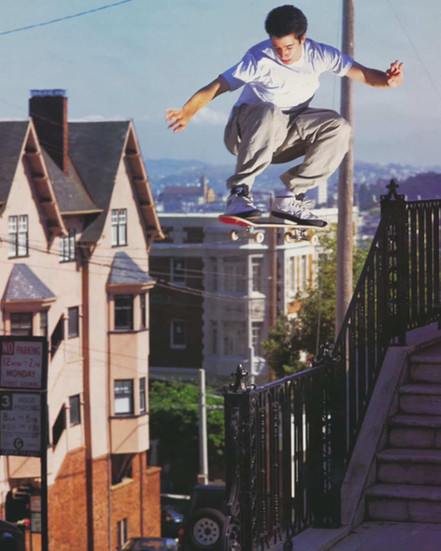
A young man is suspended over a board, knees tucked and soles facing the lens. Below him, a crowd watches the jump while a cameraman films the action with a camera on his shoulder. In another image, the movement is more tentative: a Hawaiian shirt, striped socks, and a pair of red and white shoes worn down by the asphalt. The photographs belong to different eras, but they tell the same story of transformation. Vans began as an industrial product; skateboarding converted it into a cultural code.
The documentary Never Catch Pigeons: And Eleven More Hard Lessons from Mr. Paul Van Doren retraces this journey through the life of the company's founder, Paul Van Doren. The film was screened for free on June 5, 2026, at the Frida Cinema in Santa Ana, California, followed by a Q&A with Steve and Cheryl Van Doren, moderated by the brand's head of archives, Catherine Acosta. The event was organized by the Muzeo Museum in collaboration with Vans and the independent cinema. The documentary’s title itself sets the tone: less of a corporate hagiography and more of a familial, industrial, and human portrait. Paul Van Doren didn’t skate, surf, or ride BMX. Yet, the shoe his company built would become a constant presence in all of those scenes.
A Factory Before the Subculture
The story begins on March 16, 1966, in Anaheim, Southern California. Paul and James Van Doren, along with Gordon Lee and Serge D’Elia, opened the Van Doren Rubber Company. Their first store didn’t just sell shoes; it manufactured them right in the back, closing the gap between the factory and the customer. In those early years, the company produced numerous models and sold the footwear almost immediately after assembly: you could order in the morning and pick them up in the evening.
Among these was the Style 44, known today as the "Authentic." Canvas, low profile, simple construction, and a vulcanized sole. It wasn't born as a symbolic object. It was a simple shoe—relatively cheap, durable, and easy to customize. These were practical features, not cultural strategies. But it was that very practicality that allowed the shoe to leave the shop and start a second life. In 1970s California, skateboarding was still defining its own form. Empty swimming pools became surfaces to cross, residential streets turned into downhill runs, and parking lots became meeting points. In this environment, a shoe was judged less by the narrative surrounding it and more by what it allowed you to do: grip, board feel, and durability. Vans were chosen long before they were consecrated.




The Project Passes into Skaters' Hands
The most significant turning point came in 1976 when Tony Alva and Stacy Peralta helped design the Style 95, later renamed the "Era." The model introduced a padded collar and new color combinations, becoming the go-to shoe for a generation of skaters. It wasn't just a company observing a scene and trying to sell it something; the skaters themselves were intervening in the product’s design. A year later came the Style 36, now the "Old Skool." It was the first Vans model to feature the "Sidestripe" (born from a doodle by Paul Van Doren) and integrated leather panels and suede reinforcements to better withstand the abrasion of grip tape. Introduced in 1977, the Slip-On quickly spread across Southern California as it was adopted by the skate and BMX communities. By 1978, the Sk8-Hi raised the structure above the ankle, offering better protection from board impact.
Every model was born from the intersection of function and style. But in skateboarding, the two are never truly separable. The reinforcement becomes an aesthetic line. The padding reshapes the silhouette. A worn-out sole tells the story of how a person uses their body and moves through space. This is how a shoe stops being just an accessory.
An Uniform Without a Regulation
Subcultures build their own uniforms without publishing manifestos. They define them through repetition: the same model worn in parking lots, at concerts, in low-budget videos, and on ramps built in backyards. Belonging isn't declared; it's recognized. Vans grew within this visual grammar. Not because every skater dressed the same way, but because certain objects became points of contact between distant communities. A shoe seen in California could reappear years later in a European plaza, a record store, under the stage at a punk show, or in a photograph printed in an independent magazine. In 1982, the checkerboard Slip-On gained much wider visibility thanks to the film Fast Times at Ridgemont High. In the following years, the brand expanded its presence into music and alternative cultures; in 1995, it took the Warped Tour to a larger scale, solidifying the intersection of skating, punk, and nomadic youth.
The transition from a local scene to a global market inevitably creates tension. The more a code becomes recognizable, the more it can be separated from the context that produced it. The shoe intended to be worn down on a board becomes a fashion item, a collaboration, an archive, a nostalgic reference. But widespread popularity doesn't automatically erase its origins. It makes them a point of contention.
Archiving What Was Born on the Streets
Today, the history of Vans is preserved through documentaries, corporate archives, re-editions, and photography. It’s a process common to mature subcultures: what once seemed marginal enters museums, cinemas, and historical publications. Images of 1970s and 90s skateboarding thus take on a new function. They don't just document tricks, people, or shoe models; they show the collective construction of an aesthetic. Bent bodies, baggy pants, high socks, makeshift ramps, and cameras close to the action. Every detail contributes to a language that fashion, photography, and advertising would later assimilate.
The documentary on Paul Van Doren returns to the starting point of this story: a New England entrepreneur who didn't practice the disciplines with which his name would forever be linked. The paradox is only apparent. Cultural products never fully belong to those who create them; they are rewritten by those who use them. Vans built the shoe. Skateboarding gave it posture, memory, and meaning. And it continues to wear down the soles, reminding us that some icons become such not when they are kept intact, but when someone decides to ruin them in just the right way.


Comments