.png)
Posters, Clothes, and Clutter: The Emotional Archive of a Pre-Social Media Generation
- Youth Magazine

- Jul 24
- 4 min read


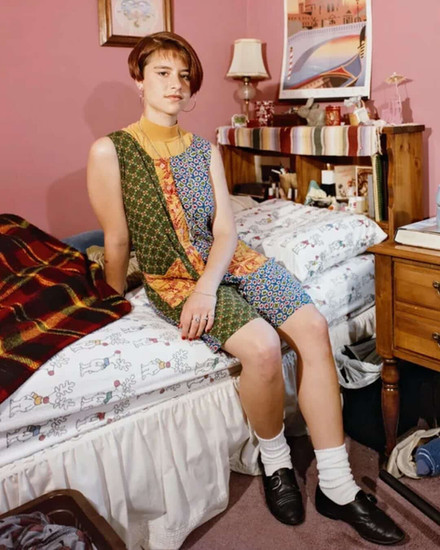
A girl sits on the edge of her bed, hands propped behind her back. Around her, a plaid blanket, illustrated sheets, wooden furniture, and small objects left in no apparent order coexist. Nothing seems staged. Yet, every detail speaks. In Adrienne Salinger’s photographs, the bedroom isn’t just a background. It is an extension of the body—a self-portrait composed before anyone had even learned to use that word. Posters, records, clothes, and photographs tell stories of desires, belongings, and contradictions with a precision that no pose could ever replace.
The project began in the late eighties and early nineties and was published in 1995 under the title In My Room: Teenagers in Their Bedrooms. Salinger entered the private spaces of dozens of American teenagers, photographing them and capturing their stories through long conversations. Thirty years after its initial release, the work has returned in a new expanded edition published by D.A.P., featuring 26 previously unreleased images.




The Room Before the Photograph
Salinger often met her subjects in malls or on the street. She would ask to photograph them at home under one condition: they were not to clean their rooms before her arrival. The goal wasn’t to catch them in a secret act, but to prevent the space from being transformed into a "presentable" version of the self. The sessions could last for hours. The photographer talked with the teenagers, showed them Polaroids, and used continuous lighting so they could understand how they would appear in the image. It was a way to reduce, as much as possible, the power imbalance between the person holding the camera and the person being observed. The subjects often look directly into the lens—they aren't bodies exposed by an adult gaze, but presences responding to it.
This tension distinguishes the series from typical adolescent photography built on stereotypes. There are no generic rebels, honor students, or romantic figures consumed by angst. There are specific people immersed in specific environments. Their rooms hold on to stuffed animals and religious symbols, musical instruments and car photos, pop idols and traces of childhood. The past has not yet disappeared, while the future has already begun to take up space. Salinger described this exact condition as the moment when what was and what will be end up compressed onto the same shelf.
An Identity Made of Things
Before social media, building a visible identity took time. A poster had to be found, bought, brought home, and tacked to the wall. A photograph stayed in the same spot for months. A t-shirt, a record, or a deck became signs of belonging not because they appeared in front of thousands of people, but because they were chosen and kept. The bedroom was both a sanctuary and a statement. It was a space carved out from the adults, yet not entirely independent of the family—a private place that hosted public codes, from music to fashion, from subcultures to religion. Its aesthetic didn't come from a conscious composition; it accumulated.
It is this accumulation that makes these images so readable today. Fashion changes, and certain objects become instantly datable, but the underlying mechanism remains recognizable: using what surrounds us to figure out who we might become. In these photographs, clothes don't function as "styling." A baggy shirt, a patchwork dress, a pair of shorts, or a band tee are part of the same system as the walls and furniture. They don't separate the subject from their environment; they tether them to it. Even when some looks seem surprisingly contemporary, their power doesn't depend on the cyclical return of trends. It depends on the fact that they hadn't yet become "references."
From Sanctuary to Permanent Set
Today, the construction of adolescent identity no longer happens solely within a room. It moves through profiles, chats, photo archives, short videos, and different, often overlapping, audiences. The private environment still exists, but it can transform at any moment into a backdrop to be shown. The difference isn't just the shift from analog to digital; it's about the presence of an audience.
The rooms Salinger photographed were visible to a few friends, family members, and, exceptionally, the photographer. They didn't have to withstand the daily gaze of strangers. They didn't have to be updated to remain "relatable." This doesn't mean that adolescence in the nineties was more authentic. Identities were already shaped by music, advertising, cinema, and social hierarchies. But those codes could settle in a less exposed space, where changing your mind didn't require deleting a post and where a contradiction could sit on the wall right next to another. In the new visual ecosystem, the self-portrait has become continuous. It is no longer produced only through what one owns, but through what one decides to make visible. The bedroom can be both a sanctuary and a photo studio, a place of isolation and an access point to a global community. The boundary between inside and outside hasn't disappeared—it is negotiated every day.
What the Walls Remember
The text that accompanied the original book further expanded the scope of the images. The teenagers spoke about family, racism, addiction, death, sexuality, and pregnancy. The room might have looked protected, but it wasn't separate from the world. It contained the social, economic, and family pressures that ran through their lives. Because of this, Teenagers in Their Bedrooms isn't just an aesthetic catalog of the nineties. It is an archive of people caught while trying to find a shape, before that shape is stabilized by adulthood or turned into a permanent public identity.
Looking at these photographs today, the most distant detail isn't the haircut, the stereo model, or the poster hanging above the bed. It’s the very idea of a room capable of sheltering a person without needing to immediately communicate them to the world. The walls were already a profile. They just didn't ask to be updated, shared, or liked. They just stayed there, in the mess, while someone grew up.
PHOTO: Adrienne Salinger: Teenagers In Their Bedrooms (Copyright © Adrienne Salinger, D.A.P, 2025)


Comments