.png)
Doodles Become a Language: How Joe Whale Turned a Schoolhouse Scolding into a Visual Narrative
- Youth Magazine

- Jul 24
- 4 min read
Updated: 5 days ago


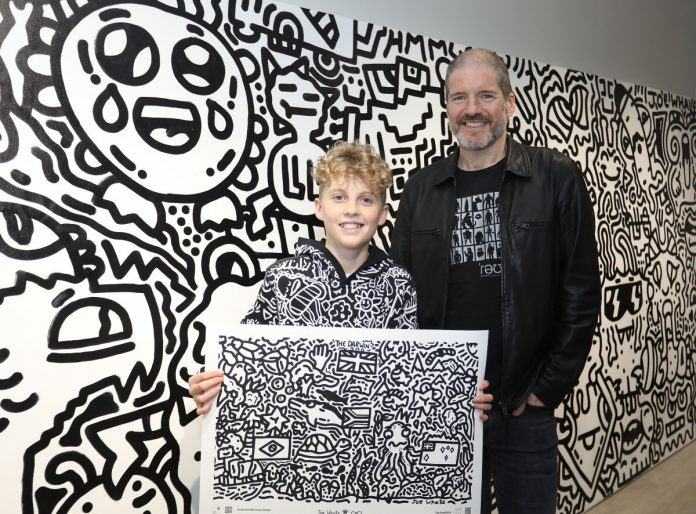
A black line runs along the wall, meets a face, turns into a monster, and unfolds into an imaginary city. In Joe Whale’s drawings, empty space hardly exists; every surface seems to beg to be inhabited. His story went viral in 2019 when he was just nine years old. At school, he was constantly drawing in his notebooks and on any available surface, earning him reprimands from teachers who viewed his sketches as a distraction. Instead of pushing him to stop, his parents decided to enroll him in an after-school art class. From there, some of his work found its way online, leading to the commission that would change the scale of his art: decorating a wall at the Number Four restaurant in Shrewsbury. Today, Joe Whale is sixteen, lives in Adelaide, and continues to work under the name "The Doodle Boy." In the meantime, he has had exhibitions, books, a Royal commission, and collaborations with brands like Nike, Disney, and Marks & Spencer. However, the most interesting shift isn't the move from the notebook to the global brand; it’s the transformation of the doodle from a marginal gesture into a recognizable language. While the school saw a distraction, he was already using his drawings to build a world of his own.
Doodling as a Free Space
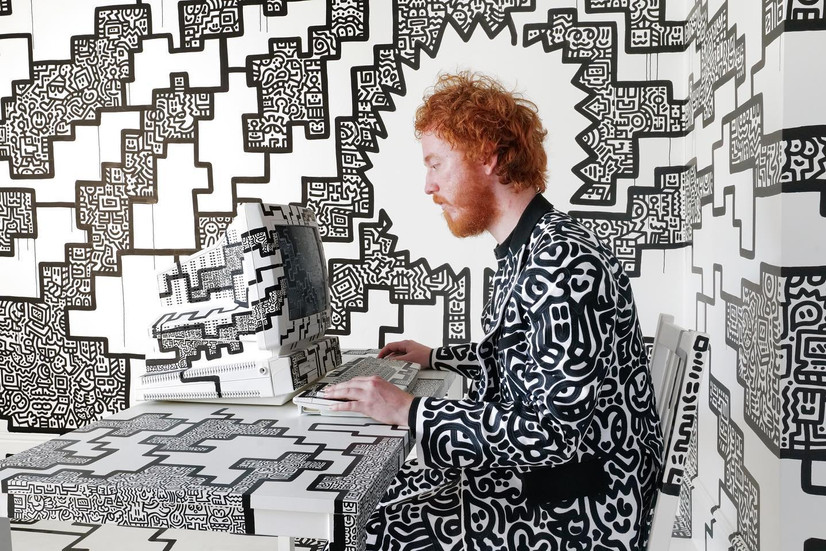
Doodling is one of the first visual gestures we learn. It comes before technique, and often, even before intention. It’s a repetitive movement made during a phone call or in the margins of a page while our attention seems to be elsewhere. Because of this, it’s usually considered temporary—something to be erased, not preserved. Joe Whale worked within this seemingly minor zone. His compositions are populated by eyes, teeth, hybrid creatures, anthropomorphic objects, and architectures that grow into one another. The stroke is direct, mostly monochromatic, and created without a search for realistic depth. Every figure seems to carry the same weight as the rest. There is no stable center, only a continuous accumulation. It’s a visual grammar close to the logic by which a generation raised in front of screens organizes images: simultaneous, dense, and navigable in multiple directions. The eye isn’t guided toward a single subject; it’s invited to get lost.



His work has often been framed through the reassuring lens of the child who turns a scolding into success. But stopping there reduces everything to a motivational parable. The broader issue concerns how institutions recognize creativity, especially when it doesn’t take the required form. In a classroom, drawing is usually expected to appear at the right time, on the right paper, following a specific assignment. Spontaneous drawing, however, can be interpreted as a lapse in focus. In Whale’s case, the problem wasn't a lack of interest, but a visual impulse difficult to contain within the structure of a lesson. His talent only became visible when an adult decided to move it into a different context.
From the Margin to the Wall
The wall at the Shrewsbury restaurant marked a concrete breaking point. The gesture that had stayed on the edges of a notebook suddenly occupied a public space. It was no longer a private mark to be corrected, but an image designed to be seen. Scale changes meaning, too. A small doodle can look accidental; hundreds of figures invading a wall become an environment, a rhythm, and a narrative. Whale’s work shows how often the line between a doodle and a piece of art depends not just on the quality of the line, but on the space it is granted. Following the online success of that project, "Doodle Boy" became a public identity. The name itself preserves something of the childlike, immediate origin of his language, but today it also risks acting as a frame that is too tight. His official website no longer presents Joe simply as the kid who got famous for drawing on walls, but as an artist working across ink, painting, animation, and film. His recent research also includes color works and larger-scale compositions. It is the delicate transition facing many artists who become famous very young: growing up without being forced to forever repeat the gesture that first made them visible.
When Imagination Becomes a Public Image
Commercial collaborations have taken Whale’s characters off the walls and into campaigns, products, and projects destined for wide audiences. It would be easy to read these solely as proof of his success. They are also a sign of how much the contemporary market seeks out languages that feel spontaneous, irregular, and immediately human. In a visual landscape dominated by polished surfaces and digitally generated or corrected images, the hand-drawn line retains a special quality. It shows the mistake, the pressure of the ink, the decision made without a way to turn back. The doodle communicates freedom precisely because it doesn't seem to obey a rigid plan—even when that freedom is now backed by commissions, contracts, and communication strategies. Here, an inevitable tension emerges: a language born as a personal impulse can become a style, a signature, and eventually a commercial identity. This doesn’t mean it loses authenticity; it means it enters a system that asks it to be reproducible and instantly recognizable.
Joe Whale stands exactly on this threshold today: no longer just the boy described by the media, but not yet an artist whose trajectory can be definitively read. His most recent evolution seems to be seeking a way out of simply repeating the "Doodle Boy" persona, expanding his materials, formats, and ambitions.
Staying Outside the Lines
Joe Whale’s story doesn't prove that every doodle necessarily hides exceptional talent. It shows something more useful: creative languages don't always appear in the form adults are used to recognizing. Sometimes they show up as clutter. As a page filled too quickly. As a child who seems not to be listening because they are building their focus elsewhere. Before the exhibitions and collaborations, there was only a mark repeated despite the reprimands. That same mark has since crossed notebooks, walls, galleries, and international campaigns. But its strength continues to lie in the point where it started: the margin. Not the leftover space on a page, but the place where a rule stops being enough and something new begins to take shape.


Comments